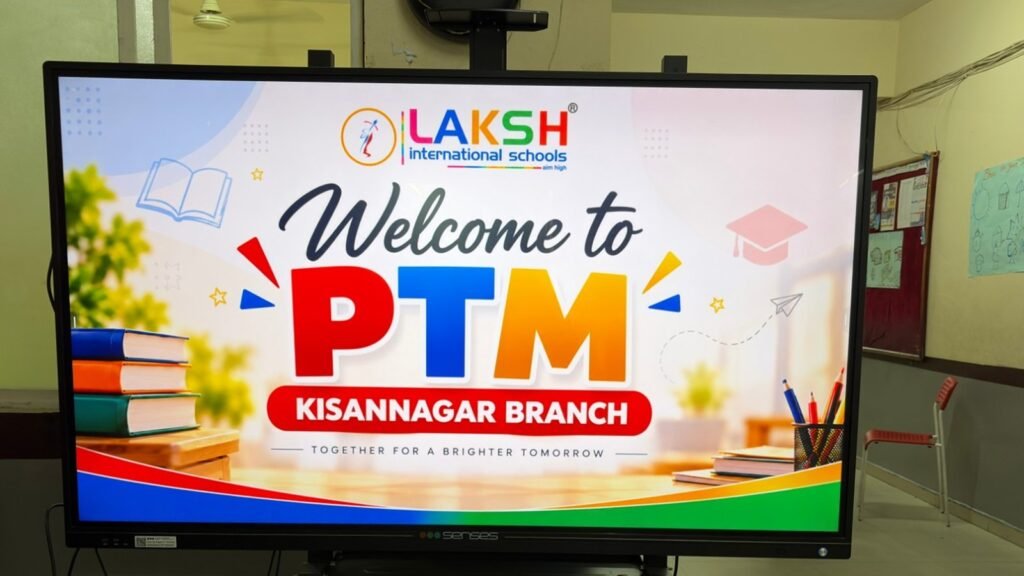
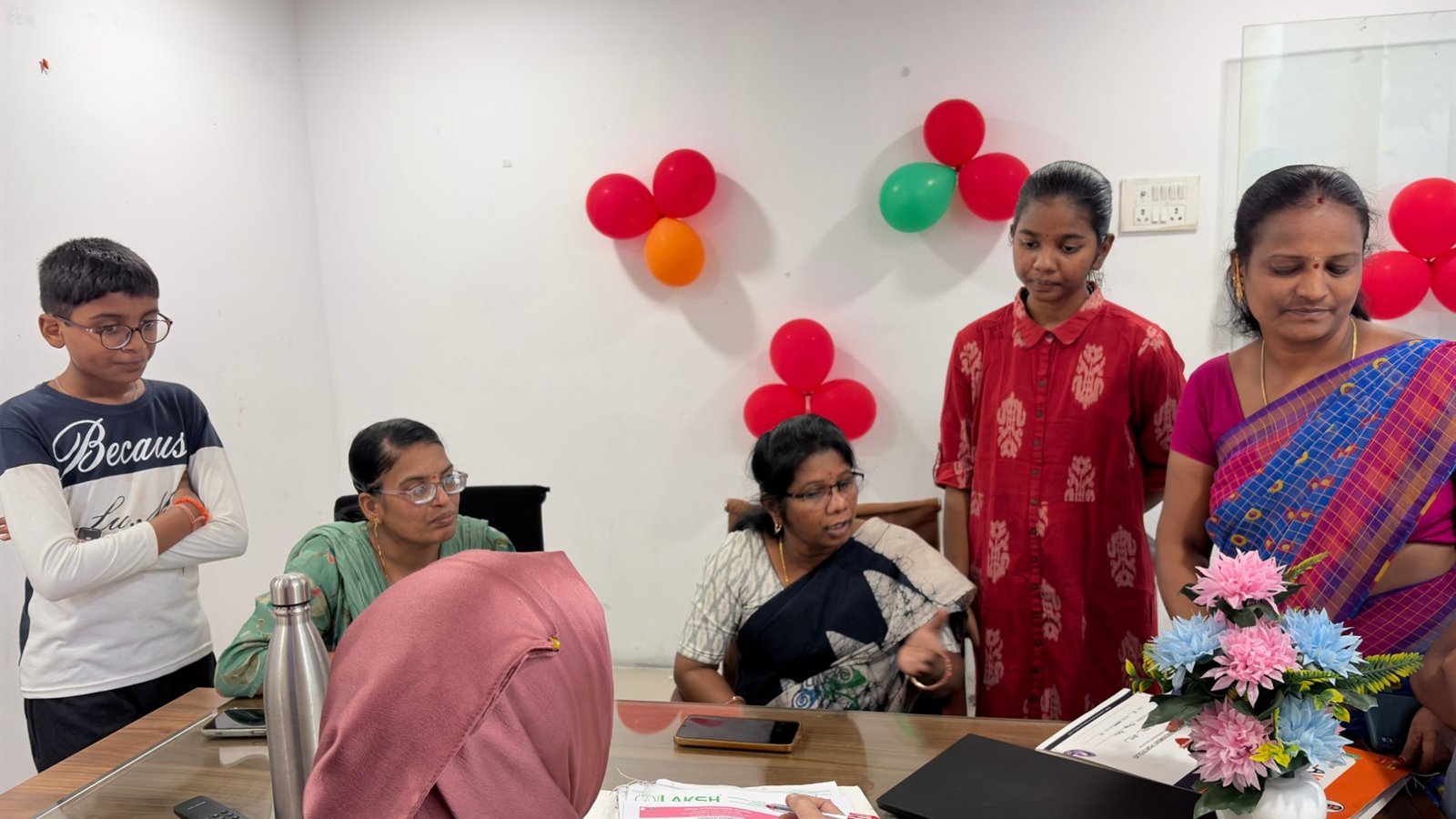
Sixty trophies were lined up on a desk at LAKSH International School, Kisannagar on Saturday, 24 October 2026 — one for every student who topped their class in Summative Assessment 1. 🏆 The same morning, parents came in for Parent-Teacher Meeting 3, sat down with class teachers, and went through their own child’s report line by line.
This article covers both: the full list of our 60 summative assessment toppers, and what happened at PTM 3 — including how to read the report your child brought home.
Table of Contents
PTM 3 at LAKSH Kisannagar: The Day in Brief
| Event | Parent-Teacher Meeting 3 |
| Date | Saturday, 24 October 2026 |
| Campus | LAKSH International School, Kisannagar, Karimnagar |
| Assessment reviewed | Summative Assessment 1 (October 2026) |
| Classes | Nursery to Grade X |
| Toppers felicitated | 60, across every class and section |
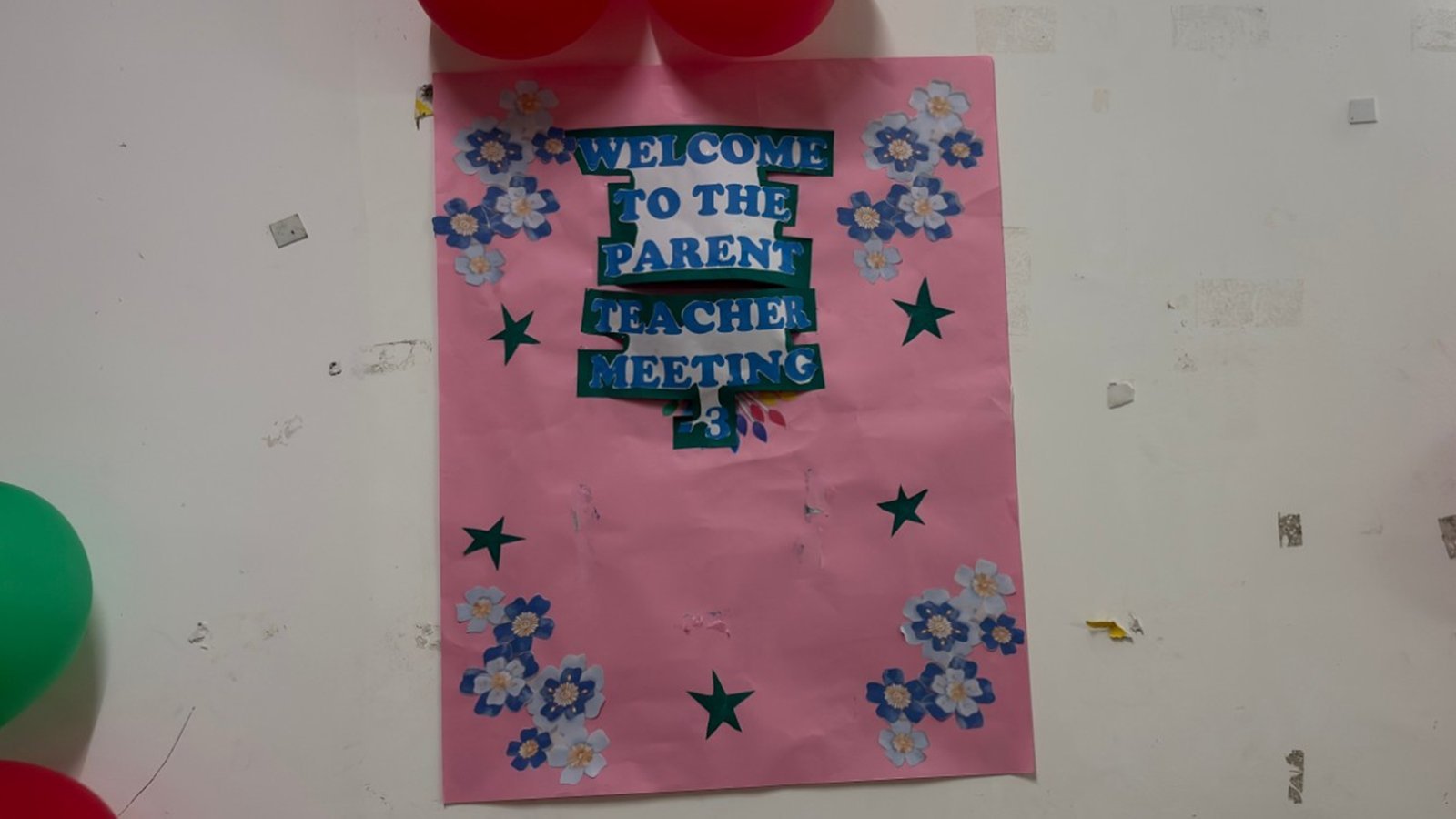
The welcome board went up at the entrance, the corridors filled, and for most of the day the school ran on a single conversation repeated many times over: here is your child, here is the evidence, here is what we do next.
What a Summative Assessment Actually Measures
Parents often ask why a summative assessment carries more weight than a weekend test, and it is a fair question.
A formative assessment happens during learning. It is the weekly test, the classwork check, the oral question in the middle of a lesson. Its purpose is to catch a gap while there is still time to close it, and it is low-stakes by design.
A summative assessment happens after a block of learning is complete. It asks a different question: having taught this, how much has actually stayed? It covers a full term’s syllabus rather than one chapter, and it forces a skill that no weekly test can — sitting with a large body of material and organising it under time pressure.
| Formative assessment | Summative assessment | |
|---|---|---|
| When | During the term, continuously | At the end of a term or block |
| Covers | A chapter or a single skill | The full syllabus taught so far |
| Purpose | Catch and close gaps early | Measure what was retained |
| At LAKSH | Weekend tests, classwork, oral checks | Summative Assessment 1 and 2 |
| Stakes | Low, by design | Reported to parents, carried forward |
That is why the summative assessment result matters, and also why it should never be read on its own. A child who scores 92 in a summative assessment after scoring 70s all term has learned how to prepare. A child who scores 78 after a term of 90s may have been unwell, or may have met a topic they never really understood. The number is the beginning of the conversation, not the end of it.
Our 60 Summative Assessment Toppers
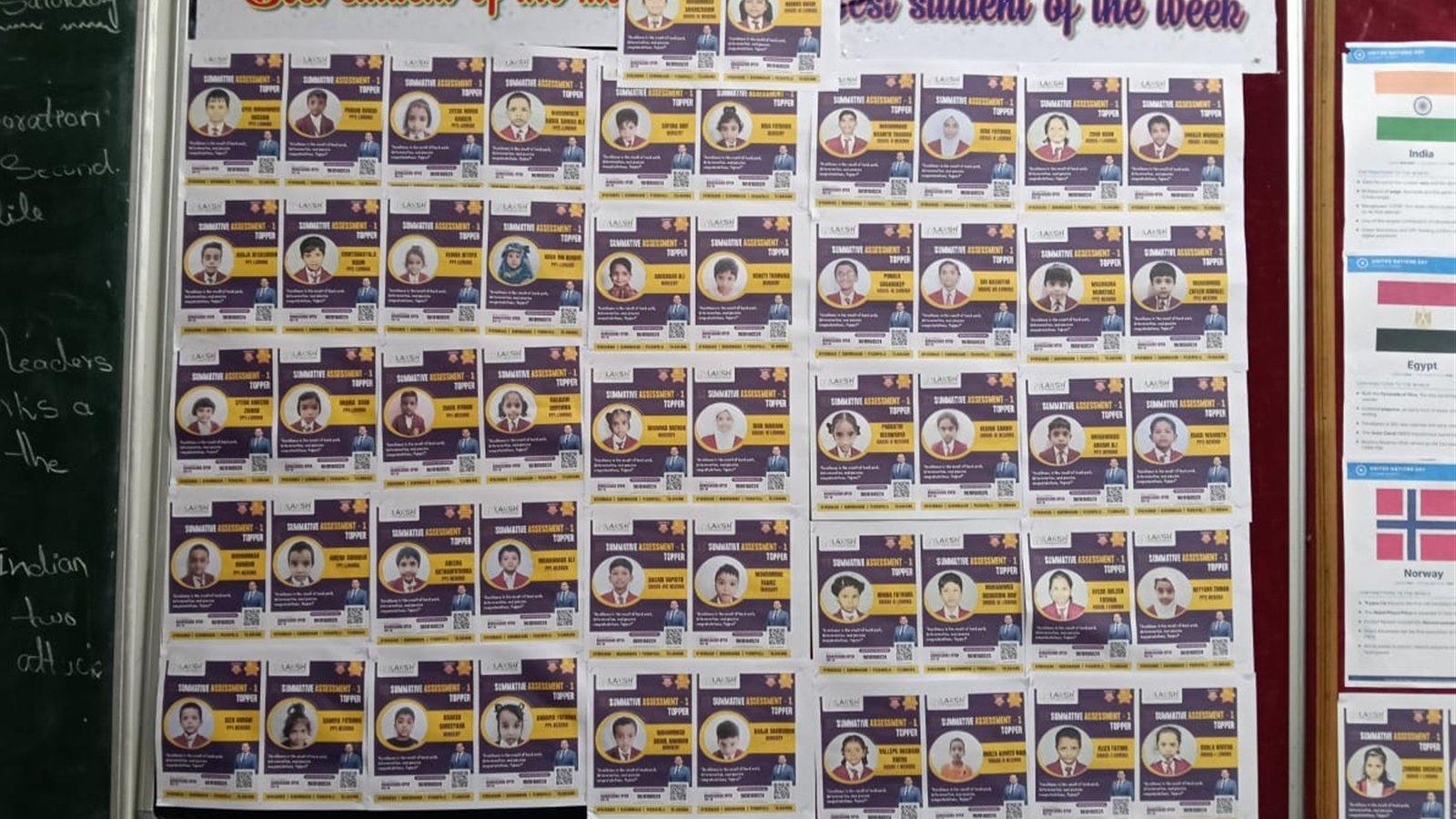
Every class and every section is represented below. These are the students who placed first in their section in Summative Assessment 1, October 2026.

| Nursery |
|---|
| Bhumika Rathod |
| Abubakar Ali |
| Safura Arif |
| Koneti Thanvika |
| Rida Fathima |
| Kadasu Shreeyaan |
| Khaja Saaduddin |
| Mohammad Abdul Rahman |
| Mohammad Faariz |
| PP1 — Nexora | PP1 — Lumina |
|---|---|
| Aiza Akram | Amena Siddiqua |
| Anabiya Fathima | Syeda Ameera Zainab |
| Areeba Akthar Fathima | Galigani Darshika |
| Samiya Fathima | Vedira Nithya |
| Mohammad Hamdan | Anabia Khan |
| Mohammad Ali | Khaja Afzaluddin |
| Shaik Ayman | Noor Ain Quadri |
| PP2 — Lumina | PP2 — Nexora |
|---|---|
| Syeda Mirha Kauser | Mohammad Arham Ali |
| Chinthakayala Viaan | Mashkura Mumthaz |
| Mohammed Abdul Samad Ali | Dhadi Mahanth |
| Puram Aviksh | Mohammad Zafeer Ismaeel |
| Syed Mohammed Hussain | Nayyara Zainab |
| Grade I — Lumina | Grade I — Nexora |
|---|---|
| Syeda Gulzar Fatima | Katkuri Rameshwar |
| Aliza Fatima | Vallepu Akshara Krithi |
| Bodla Nivitha | Umaiza Mahreen |
| Zunaira Arsheen | |
| Zoha Khan |
| Student | Class |
|---|---|
| Nimra Fathima | Grade II — Lumina |
| Mirza Ahmed Baig | Grade II — Nexora |
| Pabbathi Aishwarya | Grade II — Nexora |
| Mohammed Aqibuddin Arif | Grade III — Lumina |
| Vedira Saanvi | Grade III — Nexora |
| Manha Anam | Grade IV — Lumina |
| Mohammad Shabazuddin | Grade IV — Nexora |
| Akula Prayutha | Grade V — Lumina |
| Zubiya Fathima | Grade V — Nexora |
| Junaina Tahniyat | Grade VI — Lumina |
| Rida Mariam | Grade VI — Lumina |
| Syed Nadeef Hussain | Grade VI — Nexora |
| Kajol Rathod | Grade VII — Lumina |
| Sri Akshitha | Grade VII — Lumina |
| Mohammed Saaqib | Grade VII — Nexora |
| Dasari Suprith | Grade VIII — Nexora |
| Pokala Gagandeep | Grade IX — Lumina |
| Iqra Fathima | Grade X — Lumina |
| Mohammad Haarith Thaman | Grade X — Nexora |
How to Read Your Child’s Summative Assessment Report
Dear Parents — the report you received at PTM 3 contains more than a total. Here is how to get the value out of it.
- 📊 Read subject by subject before you read the total. An aggregate hides everything. Two children on the same total can have completely different problems.
- 📈 Compare against your child’s own earlier marks, not against the class topper. The only useful trend line is their own.
- ✍️ Look at where the marks were lost, not just how many. Blank answers mean time ran out or the topic was not known. Partly correct answers mean the idea is there but the method is shaky. These need opposite fixes.
- 🗣️ Read the teacher’s remark twice. “Needs to be more consistent” is a different message from “needs more practice”, and teachers choose those words carefully.
- 🤝 Ask one specific question. Not “how is she doing?” but “which topic should we work on first at home?” You will get a far more useful answer.
A summative assessment report is a diagnostic document. Treated that way, it is worth more than any amount of general encouragement.
Three Things That Cost Marks and Have Nothing to Do With Knowing the Answer
Every year, in every class, a predictable share of marks is lost in the exam hall by students who knew the material perfectly well. These are worth more attention than another hour of revision.
- Not reading the question fully. A child who answers the question they expected rather than the one printed loses the whole mark, however good the answer. Teach them to underline the instruction word — define, explain, compare, list — before writing a single line.
- Running out of time on the long answers. Most papers put the heaviest marks at the end. A child who spends thirty minutes perfecting the first section often reaches the final questions with ten minutes left. Practise the paper against a clock at least twice before the summative assessment.
- Leaving blanks. An attempted answer can earn partial credit; an empty space cannot earn anything. Children need explicit permission to write what they do know about a topic they only half remember.
None of these three is an intelligence problem. All three are trainable, and the improvement usually shows up in the very next summative assessment.
What Parents and Teachers Discussed
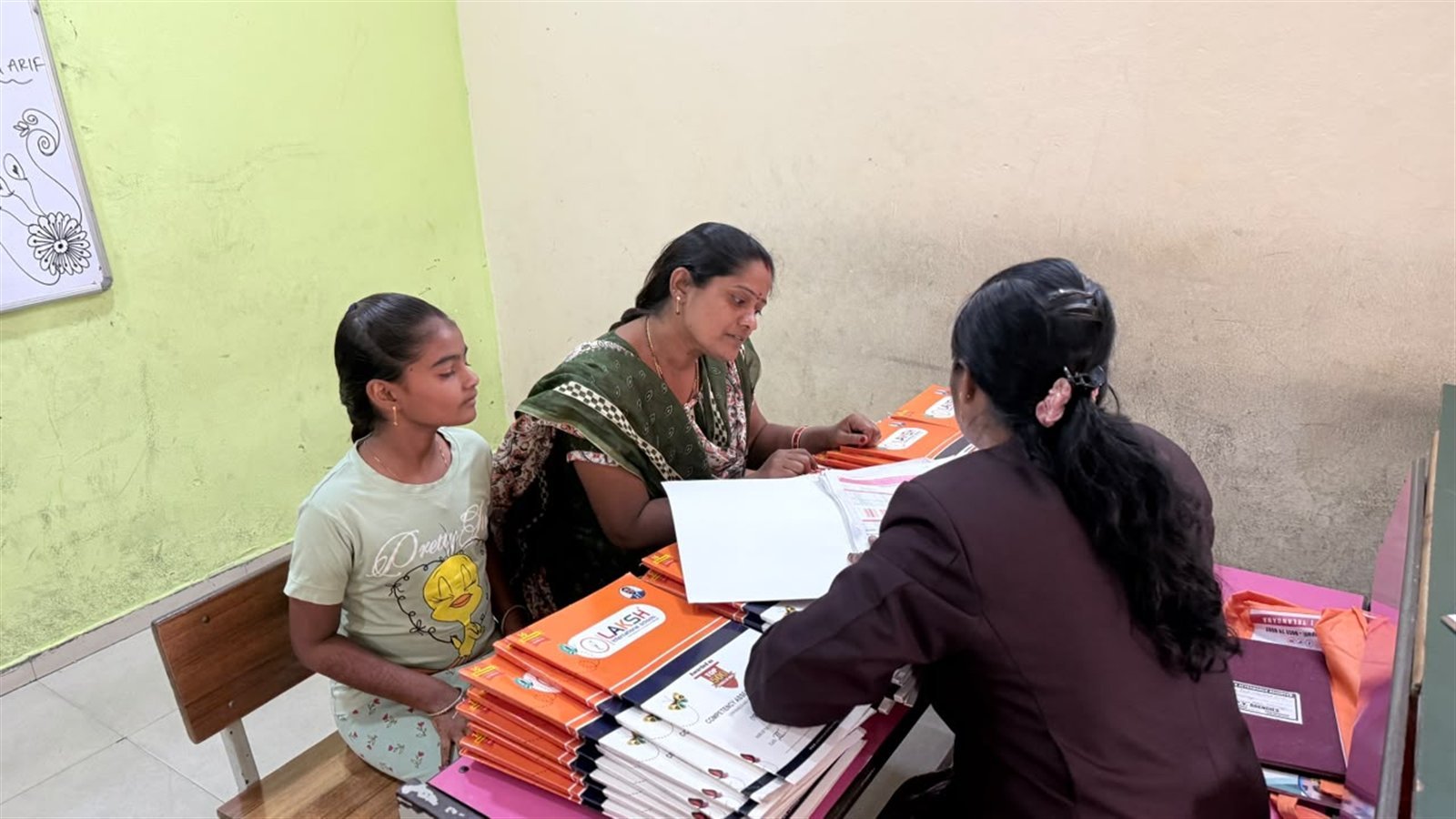
PTM 3 is deliberately structured so that each conversation covers the same ground: academic performance in the summative assessment, classwork and notebook upkeep, participation and confidence in class, attendance and punctuality, and one agreed action for the term ahead.
That last item matters most. A parent-teacher meeting that ends without a specific next step is a pleasant conversation and nothing more. Every meeting at PTM 3 was meant to end with something concrete — a reading routine, a particular topic to revise, a habit to build.
Beyond the Report Card: The Activity Corners
A PTM at Kisannagar is not only a queue outside a classroom. Several displays were put up around the school so that children and waiting parents had something to do, and so that the day felt like a celebration rather than a summons.
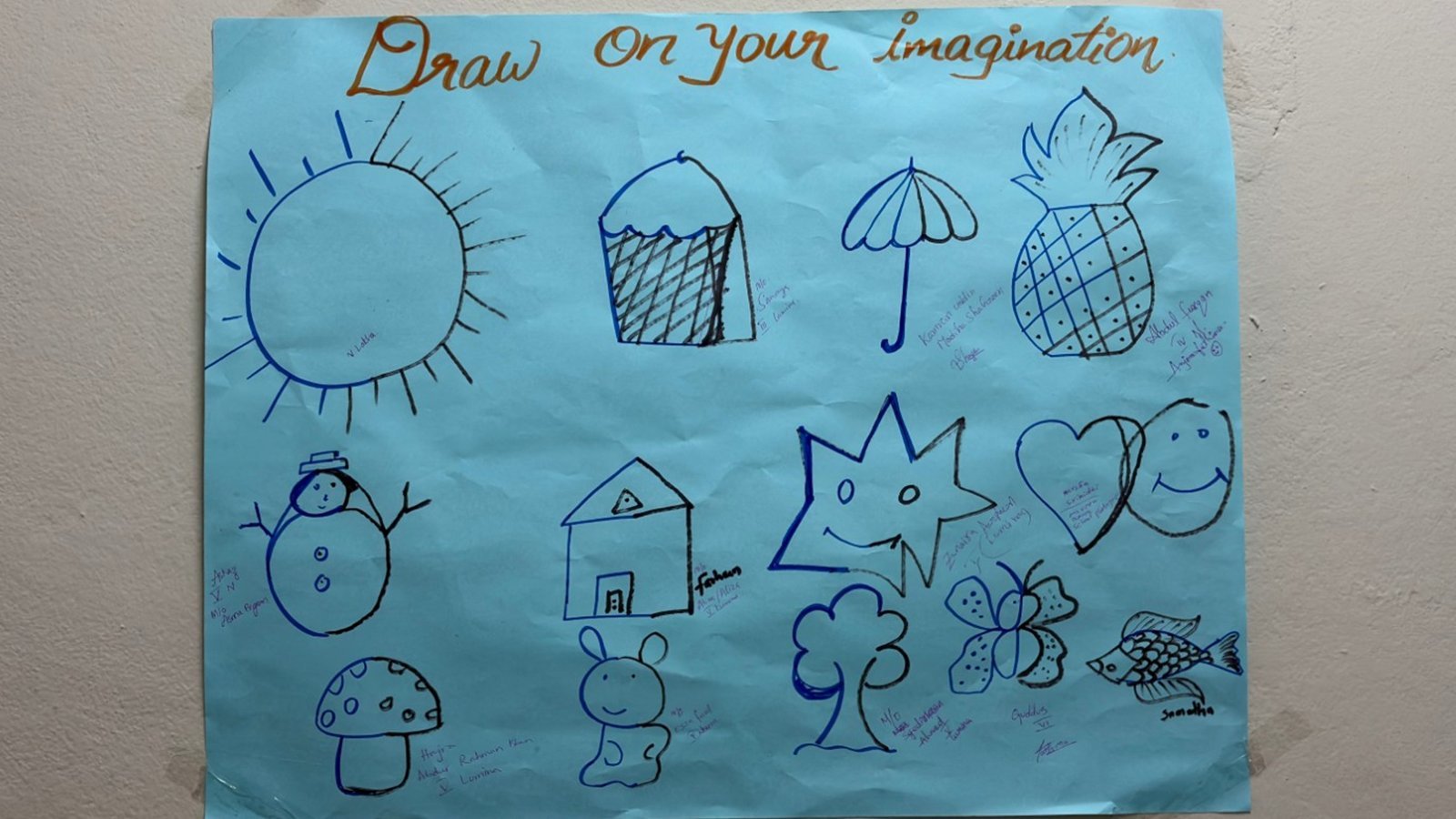
Draw on Your Imagination invited every visitor to add one small drawing to a shared sheet — a sun, a house, a fish, a snowman — each signed by the child who drew it. By the end of the day the sheet was full.
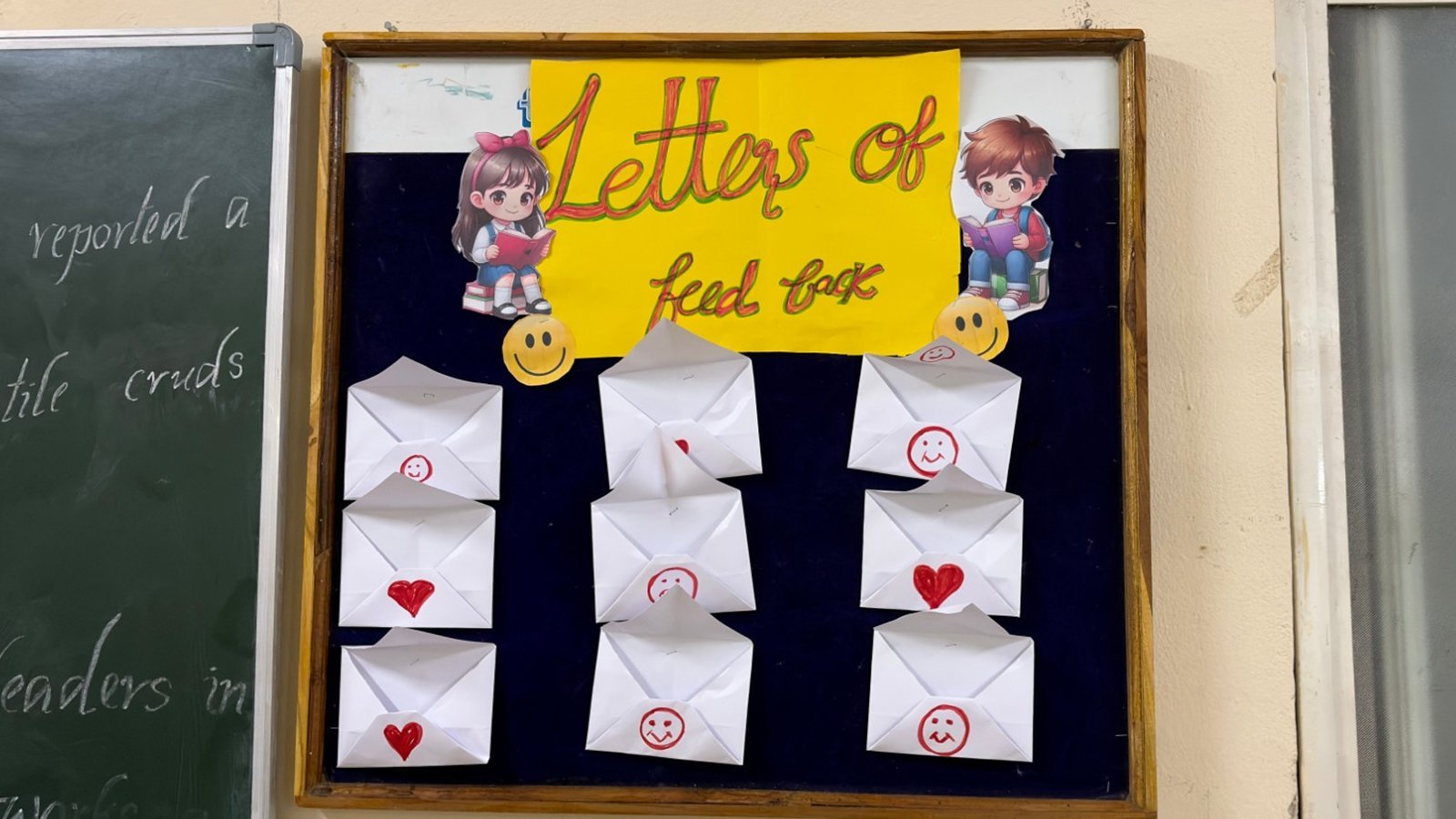
Letters of Feedback gave parents a way to say something to the school in writing, sealed in an envelope and pinned to the board. Feedback offered in person tends to be polite; feedback written privately tends to be useful.
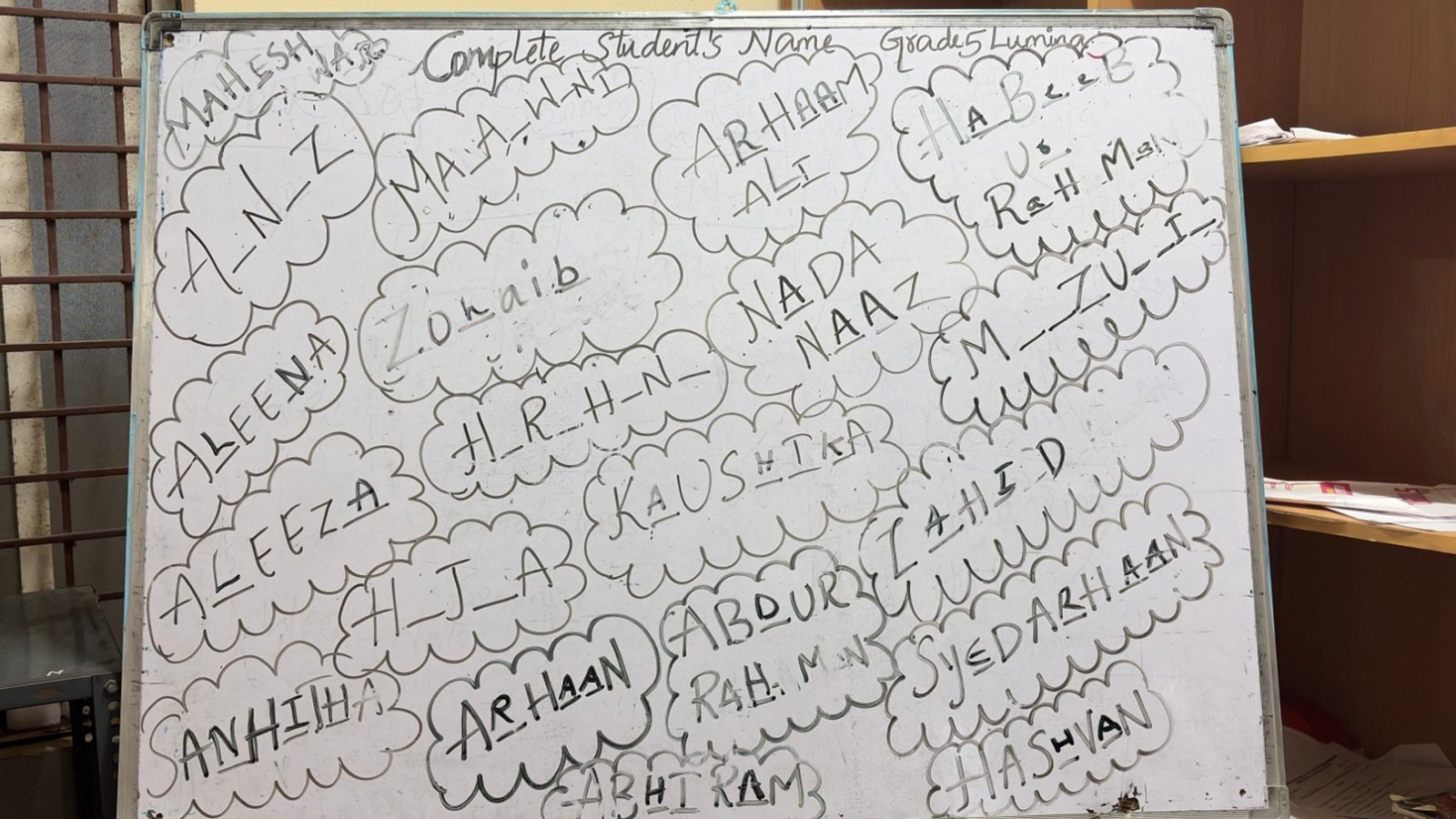
Complete the Student’s Name, run for Grade V Lumina, filled a whiteboard with half-written classmates’ names for children to finish. A simple game, and a good one for a day when children are nervously waiting to hear what their teacher will say about them.
United Nations Day on the Same Wall
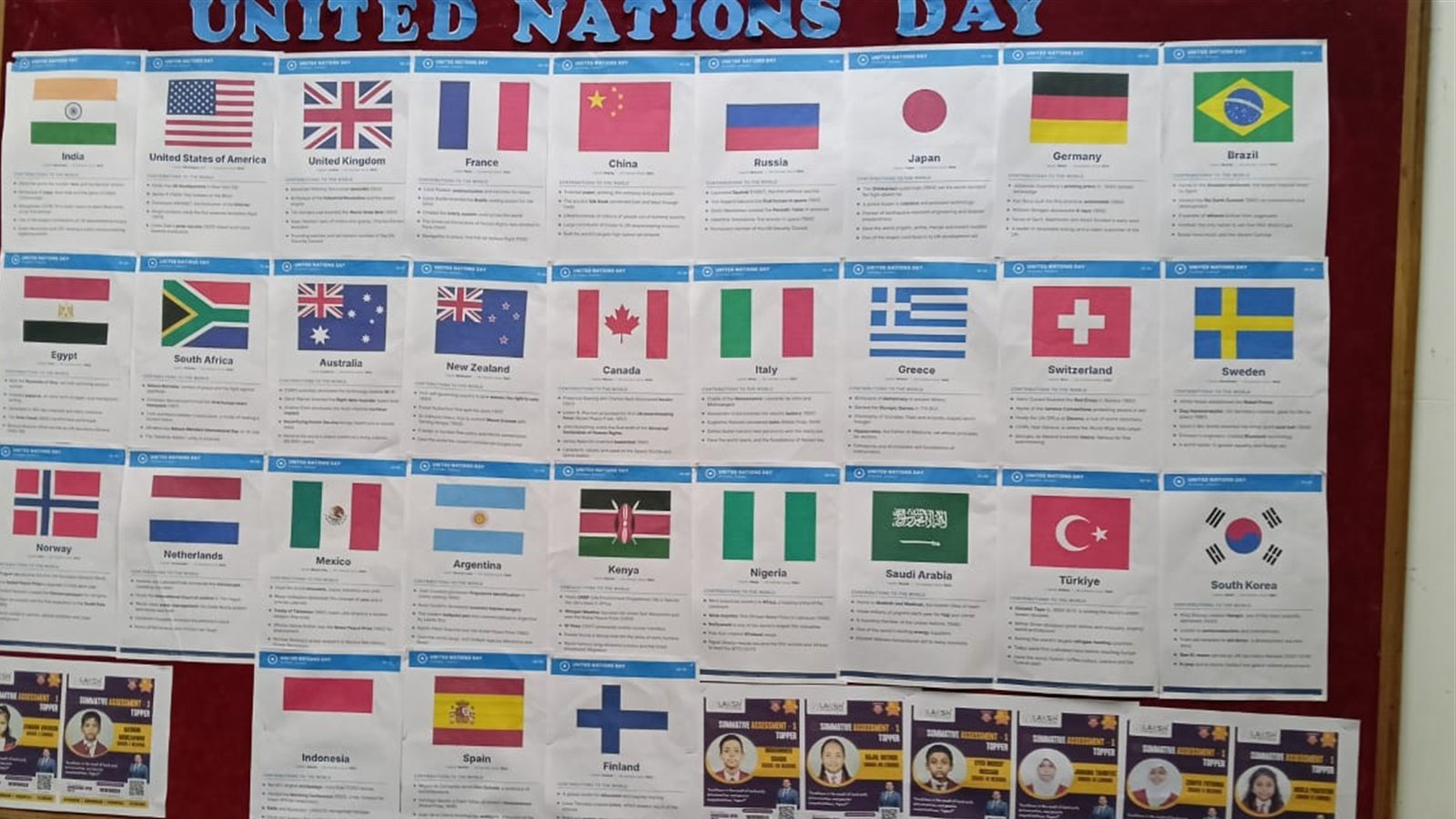
The visit also coincided with our United Nations Day display — thirty countries, each with its flag and a short note on what that nation has contributed to the world, from India and Brazil through Kenya, Türkiye, Finland and South Korea.
Placing the summative assessment topper flyers on the same board was not an accident. A child who sees their own photograph next to a wall about the wider world gets a quiet message: this is what you are being prepared for.
After the Summative Assessment: A Parent’s Next Steps
Whatever your child’s result, the fortnight after a summative assessment is when it can still be turned into something.
If your child topped the class. Say well done, and then move the goalposts gently. The risk after a strong summative assessment is not arrogance, it is coasting. Ask them to teach a topic to a younger sibling or classmate — explaining is the fastest way to find out whether you truly understood.
If your child did well but not top. Resist comparison with the topper. Identify the two subjects with the biggest gap between effort and result, and work only on those. Spreading attention across all subjects equally is the most common mistake families make after results.
If your child struggled. Separate the cause from the mark. Was the material not understood, not revised, or not finished in the exam hall? Each has a different remedy, and the class teacher can usually tell you which it was within a minute. Then pick one subject to improve before the next assessment. One.
In every case, keep the report. The next summative assessment is only meaningful when you can put the two side by side.
How LAKSH Prepares Students for Summative Assessment
Preparation at LAKSH does not begin a fortnight before the paper.
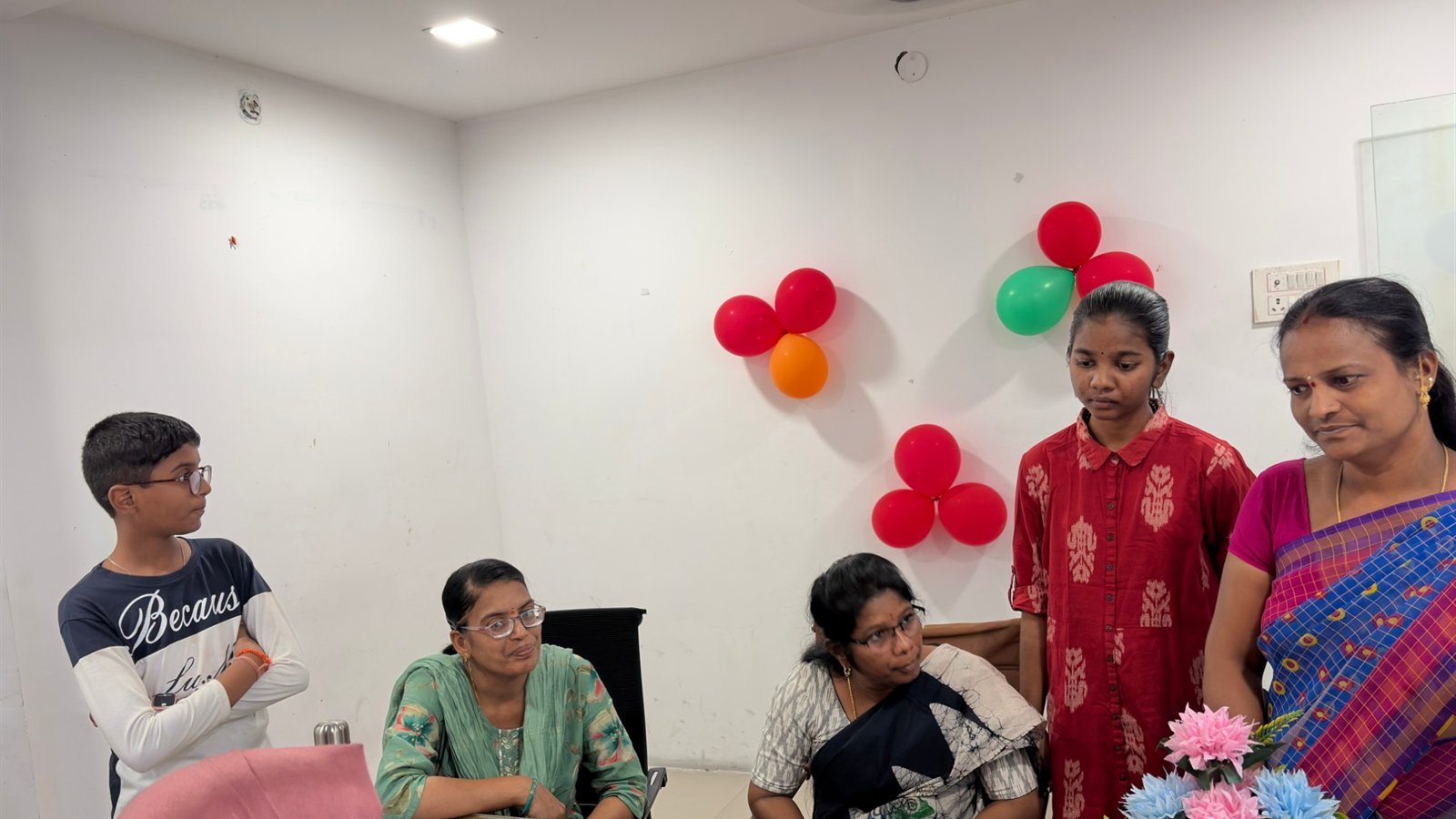
Every topic runs through our 360° Learning Model — Teach → Visualize → Experience → Express → Lead — which is built so that a concept is understood rather than memorised. Material that was genuinely understood in July is still available in October; material that was memorised is not.
Weekend tests through the term act as the formative layer, so that gaps surface early rather than in the summative assessment itself. Our teachers are trained specifically in reading these signals: the recent full-day teacher training led by our Chairman covered reading comprehension, learning approaches and child psychology precisely because those decide results more than revision timetables do.
And in our AI lab at the Kisannagar campus, students learn to research and verify rather than copy — a habit that shows up in the quality of long answers.
Why Parents Choose LAKSH International Schools
Every section gets a topper. Sixty students were felicitated, from Nursery to Grade X. Recognition at LAKSH is not reserved for the senior classes or the obvious high achievers.
Parents get evidence, not reassurance. A structured report and a real conversation at every PTM, three times a year.
Nationally recognised. Ranked 1st in Telangana and 4th in India for Technology Integration in the Education World Grand Jury Rankings, and among the Top 500 Schools of India. 🏆
Teachers who are trained continuously, across every campus, by the school’s own leadership.
Students who compete beyond the school gates — most recently at the Eenadu Pratibha painting competition and in karate championships.
Five campuses — Kisannagar, Razvi Chaman and Vijaynagar Colony in Karimnagar, plus Peddapalli and Attapur in Hyderabad.
More From Our PTM Series
Frequently Asked Questions
What is a summative assessment?
A summative assessment is an examination held at the end of a block of teaching to measure how much of a full term’s syllabus a student has retained and can apply. At LAKSH it covers the whole term rather than a single chapter, unlike the weekend tests held during the term.
What is the difference between formative and summative assessment?
Formative assessment happens during learning and is meant to catch gaps early while they can still be fixed. Summative assessment happens after learning is complete and measures the overall result. Both matter, but they answer different questions.
When was Summative Assessment 1 held at LAKSH Kisannagar?
Summative Assessment 1 was held in October 2026, and the results were shared with parents at Parent-Teacher Meeting 3 on Saturday, 24 October 2026.
How many students topped the summative assessment?
Sixty students were felicitated as section toppers across every class from Nursery to Grade X at the Kisannagar campus.
How should I read my child’s summative assessment report?
Read it subject by subject before looking at the total, compare it against your child’s own previous results rather than the class topper, note whether marks were lost to blank answers or to partly correct ones, and ask the class teacher which single topic to work on first.
What should I do if my child did not do well?
Find out whether the material was not understood, not revised, or not completed in time, because each needs a different response. Then choose one subject to focus on before the next summative assessment rather than trying to fix everything at once.
What happens at a LAKSH parent-teacher meeting?
Each parent meets the class teacher individually to go through the report, classwork, participation, attendance, and to agree one specific action for the coming term.
Where is the LAKSH Kisannagar campus?
H.No. 6-3-609/610, Sri Ramachandram Arcade, above SBI Bank, Mancherial Chowrasta, Kisannagar, Karimnagar – 505001.
Admissions Open at LAKSH International Schools
If you would like your child’s name on next term’s topper wall, come and see the campus first. 🌟
📍 LAKSH International School, Kisannagar — H.No. 6-3-609/610, above SBI Bank, Mancherial Chowrasta, Karimnagar – 505001
📞 Call: 90008 36969 (Kisannagar) or 96181 60524
📧 Email: lakshinternationalschools@gmail.com
Admissions are open at all five LAKSH campuses. Book a visit, meet the class teachers, and ask them anything.
👉 Apply for admission | Send an enquiry | Find your nearest campus
To every parent who came in on a Saturday, and to all sixty of our summative assessment toppers — thank you, and well done. 👏
Laksh International Schools — Learning Today. Leading Tomorrow.